


STRENGTHENING CARE IN COLLABORATION WITH PEOPLE WITH LIVED EXPERIENCE OF PSYCHOSIS IN UGANDA (SCAPE U)
Strengthening CAre in Collaboration with People with Lived Experience of Psychosis in Uganda (SCAPE‑U) is an innovative intervention designed to enhance the quality of mental health services and improve outcomes for individuals affected by psychosis, a severe mental health condition. The intervention emphasizes meaningful collaboration with people who have lived experience of psychosis within the Ugandan context. SCAPE‑U is a project implemented by YouBelong Uganda (YBU), a non‑governmental organization dedicated to strengthening community mental health systems in Uganda. The project was supported through a research grant awarded by the Wellcome Trust (UK).
The SCAPE‑U study was implemented in partnership with key national and international stakeholders, including the Ministry of Health of Uganda, Butabika National Referral Mental Hospital, Makerere University, George Washington University (USA), the Liverpool School of Tropical Medicine, and the University of Nottingham (UK).
Project activities commenced in April 2022 with a six‑month preparation phase. This was followed by a twelve‑month contextualization phase, which informed the design of the pilot and feasibility phase. The pilot and feasibility phase began in October 2023 and was initially scheduled to conclude in March 2025. YouBelong Uganda was granted a one‑year cost extension by the Wellcome Trust to enable completion of fourth‑year activities, including service‑user assessments and continued supervision of study participants.
During the contextualization phase, the study engaged 13 service users and their caregivers, 13 primary health facilities in Wakiso District with 20 primary care providers, 27 community health workers, and 8 individuals with lived experience of psychosis who had previously completed the YouBelongHOME program. These individuals were recruited as SCAPE‑U facilitators.
The external pilot and feasibility phase involved a larger cohort, including 60 service users and their caregivers, 32 primary health facilities across Wakiso and Kampala districts with 55 primary care providers, 64 community health workers, and 14 individuals with lived experience of psychosis from the YouBelongHOME program who served as SCAPE‑U facilitators.
The SCAPE‑U intervention has made a significant contribution to improving mental health care delivery in Uganda and the wider region. Key activities implemented during the study included comprehensive training and capacity‑building initiatives targeting multiple stakeholder groups.
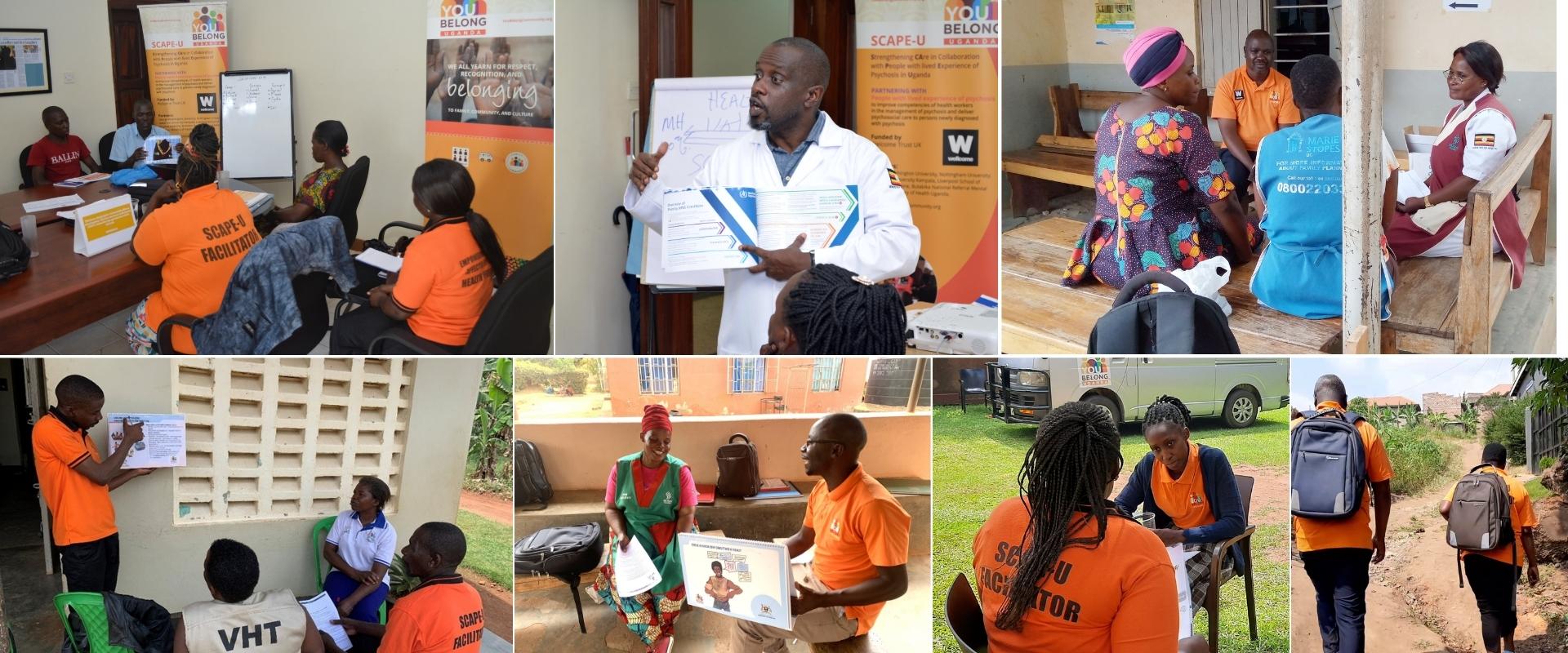 SCAPE‑U facilitators—individuals with lived experience of psychosis—received specialized training delivered by the YouBelong Uganda team using the PhotoVoice methodology, which enables participants to communicate their recovery journeys through photography. These facilitators co‑delivered training sessions for primary care providers and community health workers and conducted structured home‑based interventions for newly diagnosed service users.
Primary care providers participated in a five‑day Mental Health Gap Action Programme (mhGAP) training conducted at Butabika National Referral Mental Hospital and facilitated by mental health specialists, with co‑facilitation from SCAPE‑U facilitators. The training focused on the assessment, diagnosis, and management of psychosis, including referral pathways and the provision of psychosocial care.
Community health workers, also known as Village Health Teams (VHTs), underwent a two‑day training program delivered by primary health workers and co‑facilitated by SCAPE‑U facilitators. The training equipped VHTs with skills to identify individuals presenting with symptoms of mental illness, facilitate referrals to health facilities, and conduct community sensitization activities. VHTs further supported awareness‑raising initiatives through the dissemination of information, education, and communication (IEC) materials on psychosis.
In addition, the YouBelong Uganda team developed culturally appropriate IEC materials to support community sensitization on psychosis. These materials were disseminated to diverse target groups, including alternative care providers (such as religious and traditional healers), teachers, primary health workers, community health workers, and community members. These efforts contributed to improved identification and referral of individuals with mental health conditions to formal health services.
Service users enrolled in the study were newly diagnosed with psychosis by trained primary health workers. They received five fortnightly home visits conducted by SCAPE‑U facilitators, covering key themes such as medication adherence, stigma reduction, and management of challenging behaviors to support recovery. Service users and their caregivers also underwent follow‑up assessments conducted by research assistants at four and eight months post‑enrolment to monitor clinical and psychosocial outcomes.
Regular supervision was a core component of the intervention. Primary health workers received quarterly supervision from mental health specialists to review progress in psychosis management. Community health workers were supervised by trained primary health workers, who assessed their competencies and performance within the SCAPE‑U framework. SCAPE‑U facilitators received supervision from YouBelong Uganda supervisors, focusing on participant well‑being and role performance. Joint supervision sessions at health facilities further strengthened collaboration among primary health workers, community health workers, and SCAPE‑U facilitators.
The SCAPE‑U study protocol was successfully published in July 2025, marking a significant milestone in the dissemination of the project’s methodology and contribution to global mental health research.
